From Creator to Marketer: My Storytelling Framework for Content That Drives Clicks

I’m building this site as a marketing portfolio—a place where recruiters can see how I think, plan, execute, and measure. Before marketing became my academic focus, I learned audience behavior through creating content: what makes someone pause, what earns a save, and what actually drives a click.
Over time, I realized that strong performance usually isn’t “luck” or “trend-chasing.” It’s the result of a repeatable system: clear intent, clear structure, and consistent optimization. In this post, I’m sharing the storytelling framework I use to turn ideas into content that’s readable, credible, and measurable.


What this demonstrates (Recruiter lens)
Strategic thinking: aligning message with audience intent
Execution: repeatable content structure across channels
Measurement: tracking clicks, traffic sources, and engagement signals
Optimization: using A/B tests to improve performance over time
The Storytelling Framework: Hook → Value → Proof → CTA
Step 1: Hook (earn attention in 2 seconds)
Your hook answers: “Why should I care right now?”
As a creator, I learned that clarity beats cleverness. If the opening is vague, people scroll—even if the content is good.
Here are two hook styles I use (perfect for A/B testing):
Hook A (story/context): I used to think posting was the work—then I realized structure and distribution are the work.
Hook B (bullet/value): Here’s my 4-step storytelling framework to write content that drives clicks—without sounding salesy.
Rule: One idea. One sentence. Make it skimmable.
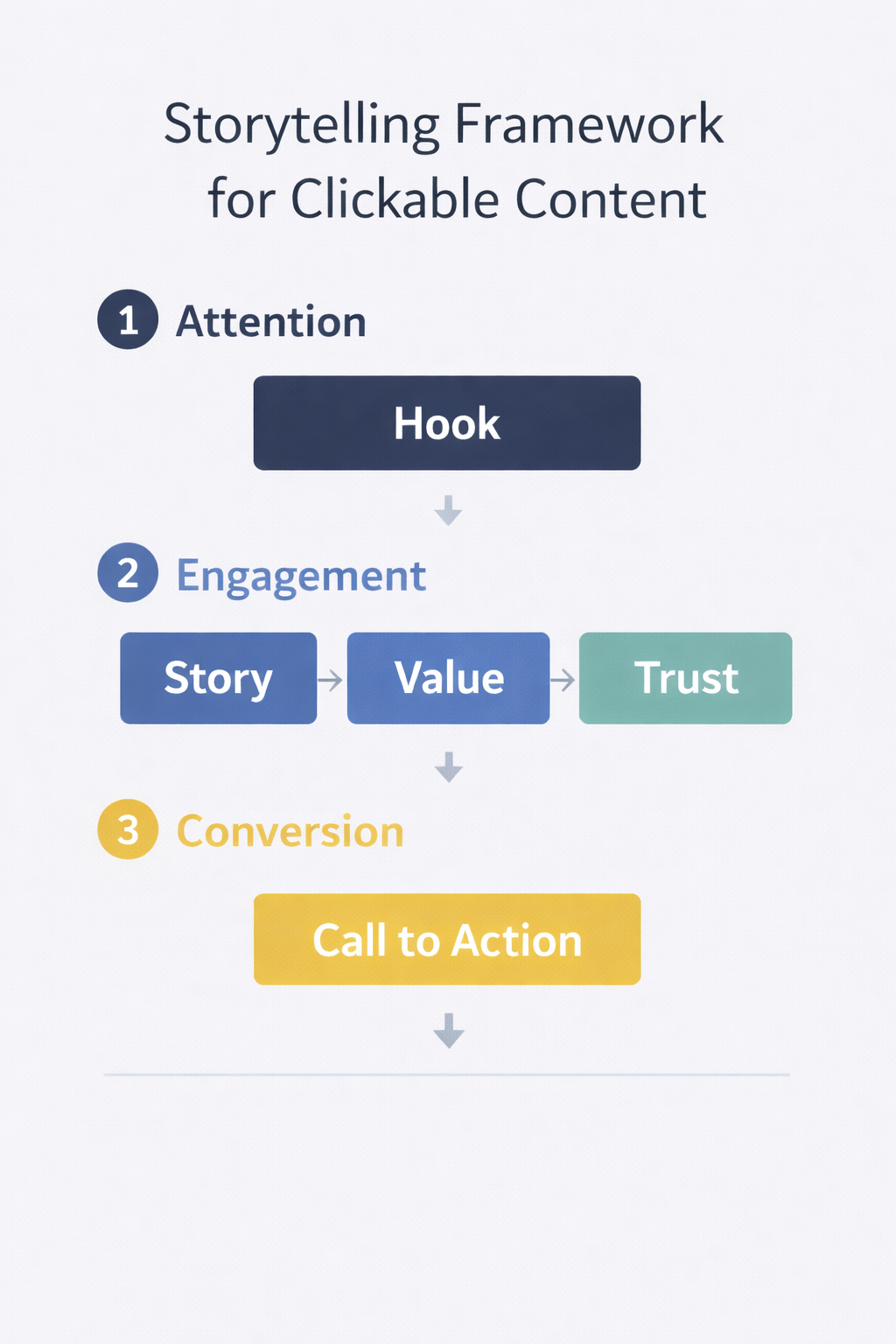

Step 2: Value (make a clear promise)
Value answers: “What will I get if I keep reading?”
Before drafting, I write one line:
Template: “In this post, you’ll get [framework/template/checklist] to achieve [result].”
Example: In this post, you’ll get a storytelling framework to write content that’s clearer, more credible, and more clickable.
This step is what turns “creative writing” into “marketing writing.”
Step 4: CTA (tell people exactly what to do next)
CTA answers: “What’s the next action?”
I keep CTAs specific and low-friction:
Read the full post here.
Comment A/B to vote.
Visit my About page to learn more.
In portfolio content, CTAs matter because they show you can guide attention—without being pushy.

Mini experiment: one simple A/B test
To keep learning (and avoid random conclusions), I test one variable only each time:
Hook A (story) vs Hook B (bullets), or
CTA A (“Read more”) vs CTA B (“Comment to vote”)
I track:
Link clicks (or CTR)
Saves/shares (signal of value)
WordPress traffic sources (what channel actually drove visits)
If you’re new to A/B testing, these two resources are helpful: Nielsen Norman Group’s A/B testing guide and Think with Google for marketing measurement and creative effectiveness.

Closing
The goal isn’t to “go viral.” It’s to build a repeatable system that proves I can connect strategy → execution → measurement → optimization. If you’re a recruiter or collaborator, you can learn more about my background on my About page and reach me.
 MarMar | Marketing & Personal Brand Blog
Leave a comment