From Creator to Marketer: My Storytelling Framework for Content That Drives Clicks

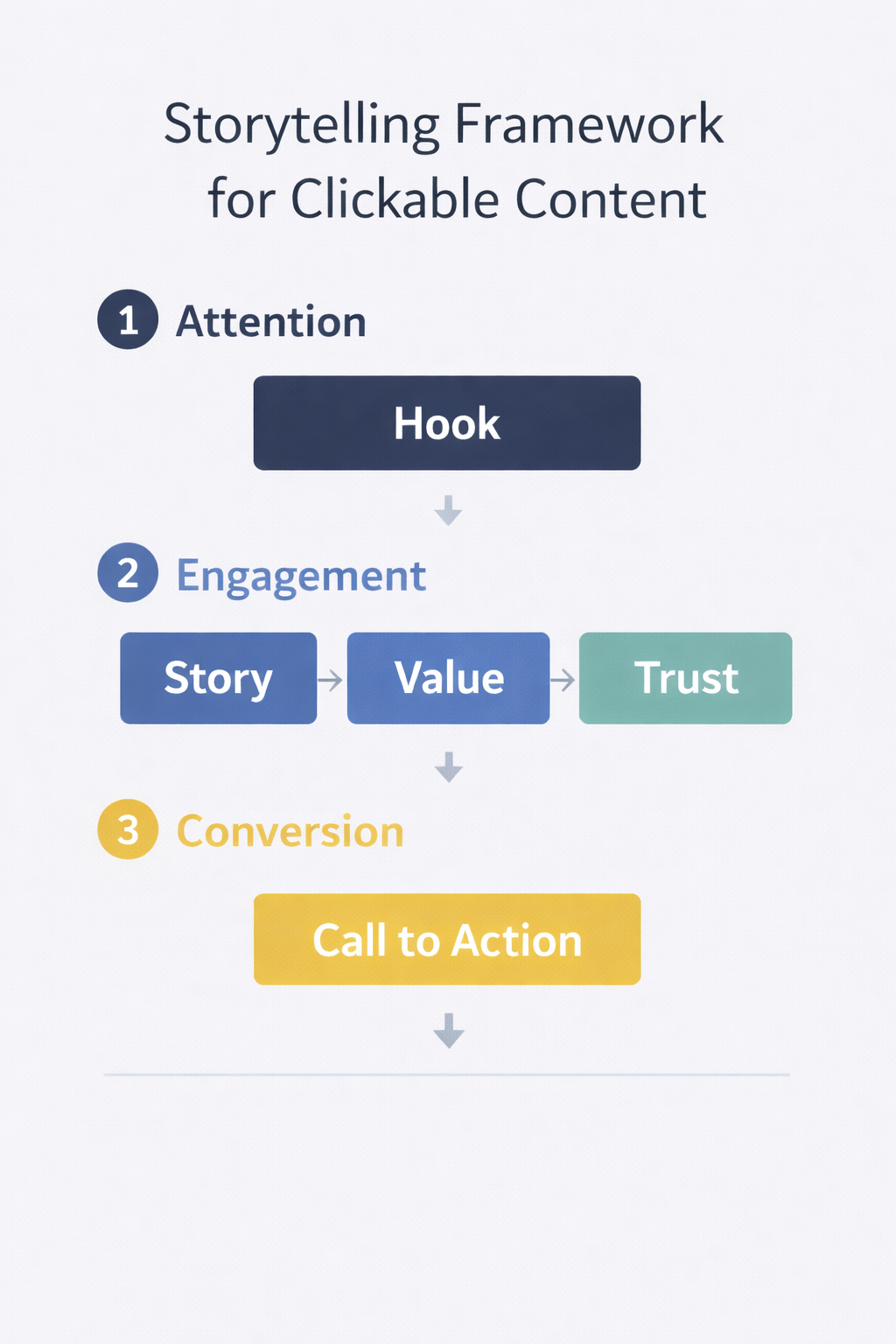
The Storytelling Framework

Hook
The hook is the first line or idea that captures attention. Its job is to stop the reader from scrolling and make them curious enough to keep reading. A strong hook usually highlights a problem, surprising insight, or relatable situation.

Proof
Proof builds credibility. It shows that the ideas are based on real examples, data, or experience rather than opinion. This can include case studies, metrics, screenshots, or personal results.

Value
Value explains what the reader will gain from the content. This is where you deliver useful information, insights, or practical takeaways that make the content worth the reader’s time.

CTA
The call to action guides the reader on what to do next. It might invite them to read another post, download a resource, connect on LinkedIn, or apply the strategy themselves.
Step 1: Hook (earn attention in 2 seconds)
Your hook answers: “Why should I care right now?”
As a creator, I learned that clarity beats cleverness. If the opening is vague, people scroll—even if the content is good.
Here are two hook styles I use (perfect for A/B testing):
Hook A (story/context): I used to think posting was the work—then I realized structure and distribution are the work.
Hook B (bullet/value): Here’s my 4-step storytelling framework to write content that drives clicks—without sounding salesy.
Rule: One idea. One sentence. Make it skimmable.

Step 2: Value (make a clear promise)
Value answers: “What will I get if I keep reading?”
Before drafting, I write one line:
Template: “In this post, you’ll get [framework/template/checklist] to achieve [result].”
Example: In this post, you’ll get a storytelling framework to write content that’s clearer, more credible, and more clickable.
This step is what turns “creative writing” into “marketing writing.”
Step 4: CTA (tell people exactly what to do next)
CTA answers: “What’s the next action?”
I keep CTAs specific and low-friction:
Read the full post here.
Visit my About page to learn more.
In portfolio content, CTAs matter because they show you can guide attention—without being pushy.

Mini experiment: one simple A/B test
To keep learning (and avoid random conclusions), I test one variable only each time:
Hook A (story) vs Hook B (bullets), or
CTA A (“Read more”) vs CTA B (“Comment to vote”)
I track:
Link clicks (or CTR)
Saves/shares (signal of value)
WordPress traffic sources (what channel actually drove visits)
If you’re new to A/B testing, these two resources are helpful: Nielsen Norman Group’s A/B testing guide and Think with Google for marketing measurement and creative effectiveness.

Why Process Matters More Than Going Viral
The goal isn’t to “go viral.” It’s to build a repeatable system that proves I can connect strategy → execution → measurement → optimization. If you’re a recruiter or collaborator, you can learn more about my background on my About page and reach me.
This is such a strong and well-structured framework! It clearly broke down storytelling into actionable steps that are easy to…
Thank you for sharing such an insightful post! these models and marketing tools truly serve as a valuable handbook for…
This is a beautifully written and insightful blog, with a strong, distinctive voice and thoughtful perspectives that make the content…
I really liked how you showed that strong storytelling in marketing needs structure, not just creativity. The Hook–Proof–Value–CTA framework was…
I especially like how you emphasized clarity over cleverness in the hook. That’s something many marketers underestimate, but it really…


 MarMar | Marketing & Personal Brand Blog
Leave a comment